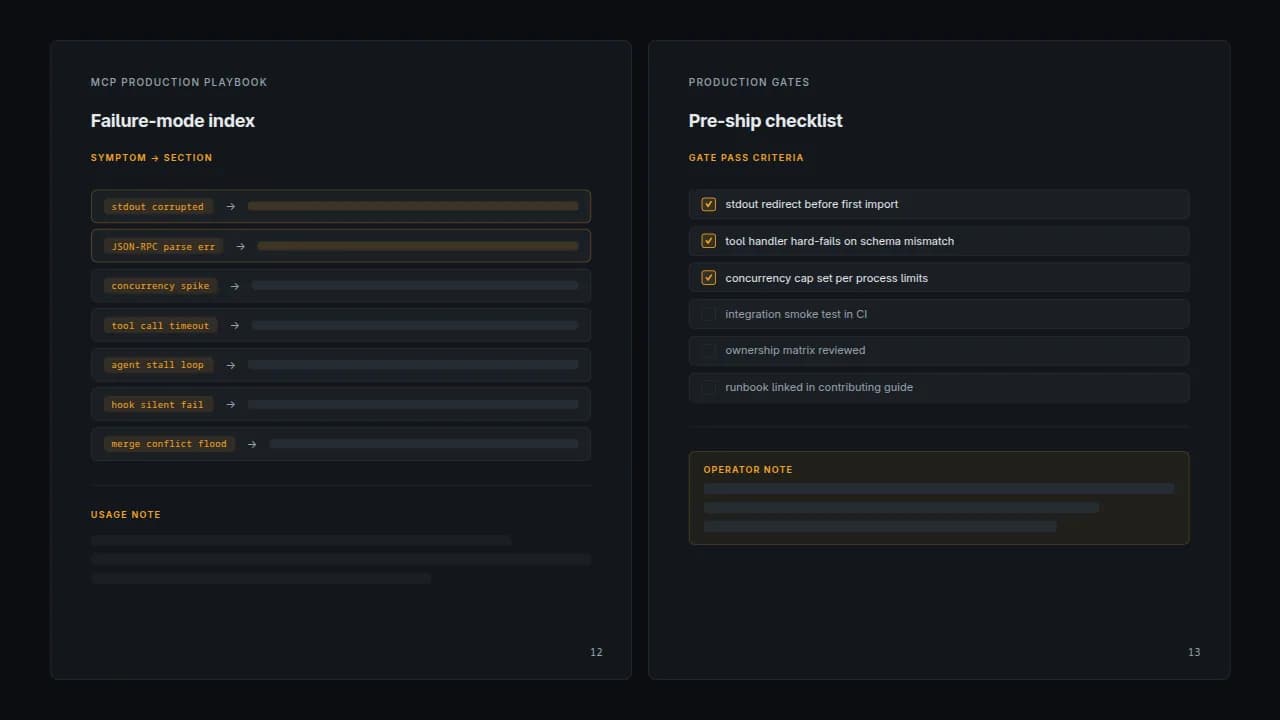
Listing previewGit template · MIT · Polar checkoutMost MCP guides stop at “hello world.” This one is written for the week after — when stdout volume, concurrency, and prod gates start behaving like real systems instead of demos.
Each chapter ties symptoms in logs and CI to decisions you can make the same day: what to buffer, what to hard-fail, and where to put ownership so incidents don’t become archaeology.
Use it as a playbook during design review, or as an onboarding spine for engineers who inherit an MCP lane mid-flight.
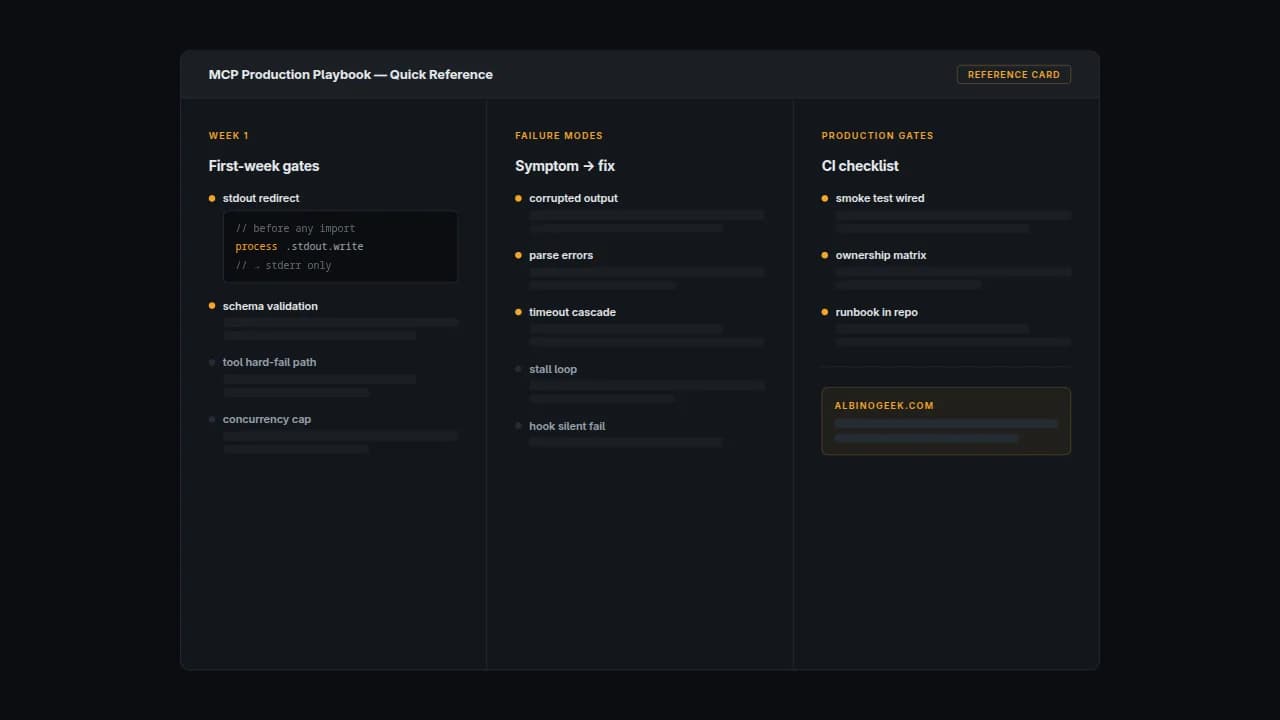
You get a PDF plus a printable reference card; Polar unlocks download access immediately after checkout.
Best fit when your team is shipping its first MCP-backed workflow to production and you need operational rigor in the first weeks, not another hello-world demo.
Intro pricing and lifetime updates apply while the intro tier stays open — see checkout for the terms in force for your purchase.
Expect a dense, reference-friendly layout built to skim in incidents: written material, not a video course.
The first 25 lines of every MCP server I write. Redirect stdout before any import fires so dependency banners don't corrupt the JSON-RPC frame, then wire initialize and one tool handler.
// mcp-server.ts — minimal production skeleton (~25 lines)
// Must be the FIRST code that runs. Redirect stdout before any import
// so dep banners and console.log calls don't corrupt the JSON-RPC frame.
const _write = process.stdout.write.bind(process.stdout);
process.stdout.write = ((chunk, ...rest) => {
const s = typeof chunk === "string" ? chunk : Buffer.from(chunk).toString();
if (s.startsWith("{") || s.startsWith("Content-Length:"))
return _write(chunk, ...rest);
process.stderr.write(chunk);
return true;
}) as typeof process.stdout.write;
const log = (...a: unknown[]) => process.stderr.write(a.join(" ") + "
");
import { Server } from "@modelcontextprotocol/sdk/server/index.js";
import { StdioServerTransport } from "@modelcontextprotocol/sdk/server/stdio.js";
import { ListToolsRequestSchema, CallToolRequestSchema }
from "@modelcontextprotocol/sdk/types.js";
const server = new Server({ name: "my-server", version: "0.1.0" },
{ capabilities: { tools: {} } });
server.setRequestHandler(ListToolsRequestSchema, async () => ({
tools: [{ name: "ping", description: "Returns pong.", inputSchema:
{ type: "object", properties: {}, required: [] } }],
}));
server.setRequestHandler(CallToolRequestSchema, async (req) => {
if (req.params.name === "ping")
return { content: [{ type: "text", text: "pong" }] };
return { content: [{ type: "text", text: `unknown tool: ${req.params.name}` }], isError: true };
});
const transport = new StdioServerTransport();
await server.connect(transport);
process.on("SIGINT", () => server.close().then(() => process.exit(0)));
process.on("SIGTERM", () => server.close().then(() => process.exit(0)));
log("[mcp] server ready");A minimal hook that always resolves the repo root from its own location — not cwd — so it runs correctly from worktrees and linked checkouts. Runs env:check and verify:dev before every commit.
#!/usr/bin/env bash
# .claude/hooks/pre-commit — runs before every Claude Code commit.
#
# Pattern: always resolve to the repo root so the hook works from any
# worktree or linked checkout (absolute path, never relative).
set -euo pipefail
# Resolve repo root from THIS script's location, not cwd.
SCRIPT_DIR="$(cd "$(dirname "${BASH_SOURCE[0]}")" && pwd)"
REPO_ROOT="$(git -C "${SCRIPT_DIR}" rev-parse --show-toplevel)"
# All yarn commands run from root so node_modules is always found.
cd "${REPO_ROOT}"
# Gate 1: env registry — blocks if code references an undeclared env var.
yarn env:check
# Gate 2: lint + types — fast; skips next build so dev server stays up.
yarn verify:dev
echo "[hook] pre-commit passed"
Engineers and leads shipping MCP-backed workflows to production — especially when you’re past the first integration and need operational rigor.
No. Examples are vendor-agnostic where possible and focus on production patterns, not a single tool’s marketing story.
Yes, while the intro tier remains open you receive lifetime updates to the PDF for that tier.
See the site Refund Policy for digital goods. Polar checkout also surfaces the terms that apply to your purchase.
From $399~$497Listing previewGit template · MIT · Polar checkoutListing previewDigital + session credit · Polar checkoutListing previewVideo call · ICS invite · written summary$29$79